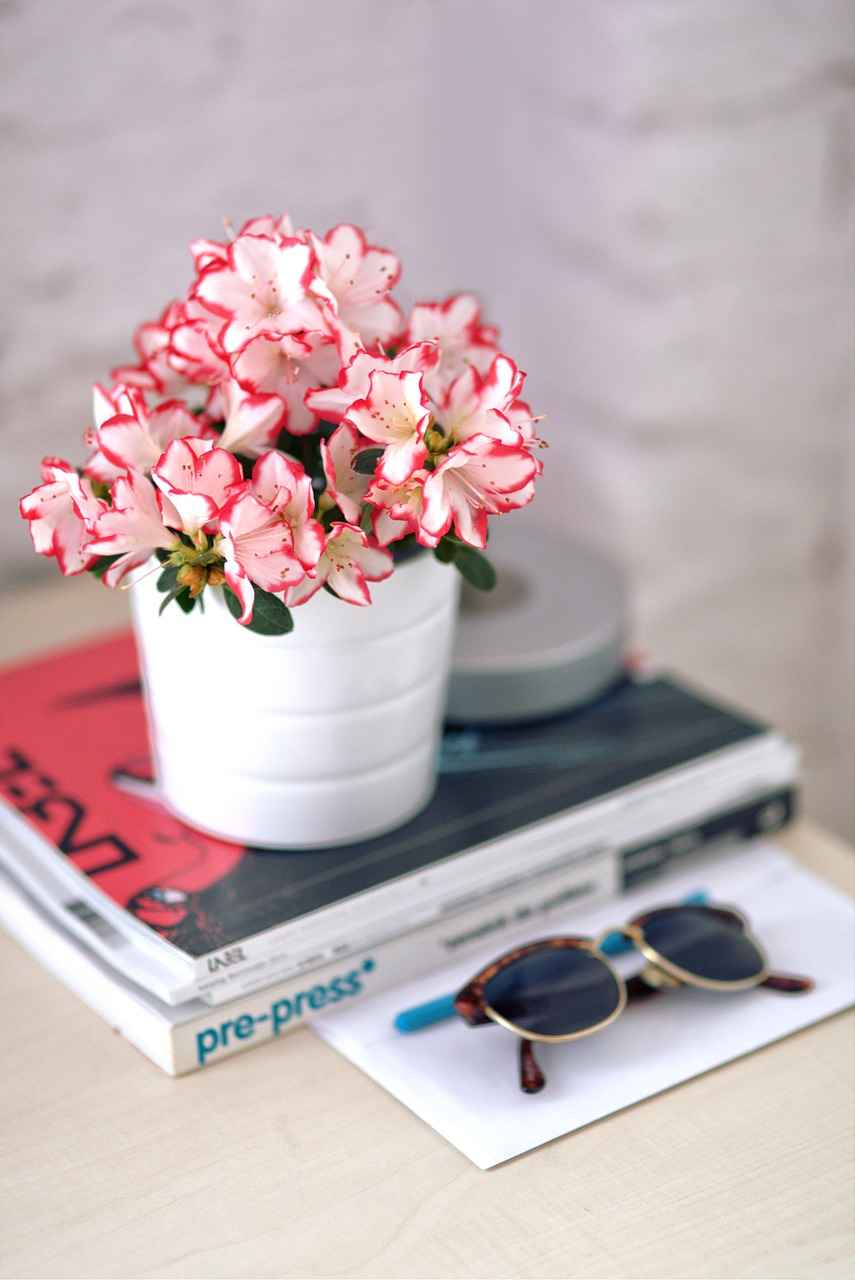
Azalea in a pot
Azalea in a pot, bought from a flower shop, is a cousin of Japanese azaleas that grow in the ground. However, her place is at home. You cannot transplant it permanently into the garden with impunity, because it will not survive the winter. This does not mean that her life is to end with the last flowers blooming.
You can have it for many years, you just need to meet a few conditions. See how the care of azaleas in a pot looks like, what this plant needs for healthy growth, how to care for the azalea after flowering and how to make the azalea in the pot bloom again. Here are all the secrets to growing potted azaleas!
Azalea in a pot – watering and fertilizing
Like the popular garden azaleas, the azalea in a pot should always have moisture at the roots. Forget about it and you will immediately see wilting flowers and sagging leaves. If you immerse the root ball together with the pot in a bucket of water in time, the plant will regain its elasticity.
Until it’s flowering, you can also dip the leaves briefly or sprinkle them as often as possible. On the other hand, flowers do not like direct contact with water, their petals stick together and lose their color. Similarly to the flowers of azaleas and rhododendrons in the garden after rain.
The water for watering the azaleas in the pot must be soft, and therefore boiled, because azalea, like all heather plants, always requires acidic soil. In a pot with little soil, the pH of the substrate can change very quickly. You need to keep the soil acidic and keep its pH in the range of 3.5-4.5 pH.
To ensure it you must use appropriate substrate when transplanting. A suitable substrate for azaleas in a pot is sour garden peat mixed with sand and a compound fertilizer with ammonium sulphate. Be careful not to overfeed! Only 1 g of fertilizer is enough per liter of substrate, which is a small pinch.
Potted azalea is a small plant that produces lots of sumptuous flowers and maintains thick leaves all year round, so it must have enough nourishment. The most important thing is to fertilize the azaleas after flowering, as then the plant is very weak.
You must fertilize plant five or six times, at 10-day intervals. You must do it with multi-component liquid fertilizer dissolved in watering water. It is even better to apply a specialized fertilizer for azaleas, giving 2-3 g of fertilizer per liter of water.
Azalea in a pot – care after flowering
Once the azalea in the pot has finished blooming, one more treatment is very important. You should remove any faded flowers by simply breaking them out with your fingers.
Then you can trim the protruding or extending branches that spoil the shape of the azalea bush. If the bush is stripped at the bottom, you can easily shorten all the twigs. After this cut, the azalea will look unfortunate, but that is ok, because you still have to move it to a cooler place, e.g. a porch, or a cold room. From the second half of May to October, it can stand in a semi-shaded place in the garden.
Then it has to go back inside house again, not to a warm room right away, but to a porch, where the temperature is between 5 and 12 ° C. It should stay there until flower buds appear.
When you see swollen buds, move the azalea pot to a warmer location. Best temperature is 18 ° C. Until Azalea opens the flowers, sprinkle the leaves, because she likes moisture in the air, and always take care of systematic watering of the soil in the pot. However, don’t go overboard with watering, as moisture does not mean the soil should be wet.
Too wet soil can rot the root system, which is not difficult to do, because azalea has fine, delicate roots. You have to find a middle ground, which is not too dry and not too wet. During the dormant period, i.e. after flowering, water the azalea less frequently, but do not overdry it.
Potted azalea care at a glance:
- in winter, azalea stands in the room and pleases you with flowers
- after flowering, you take it to cool place (5-12 ° C), prune, fertilize several times every 10 days
- at the end of May you take out to the garden, to partial shade
- at the turn of September and October you bring home, again to the porch, where it is cool
- in December or January, move to room and wait for flowers
Remember! Azalea flowers do not like direct contact with water – wet petals stick together and lose their color. Therefore, a flowering plant should not be sprayed.